
THE WOOD ELEMENT IN TRADITIONAL CHINESE MEDICINE

Finding Your Direction, Overcoming Frustration and Growing Into Your Potential
Growth. Direction. Flexibility. Possibility.
What happens when you have the desire to move forward, but something seems to be holding you back?
Perhaps you have plans you haven't acted on, decisions you've been postponing, or a growing sense of frustration because life isn't moving in the direction you imagined.
Or perhaps everything looks perfectly fine from the outside, but internally you feel restless, uninspired or disconnected from your sense of purpose.
In Traditional Chinese Medicine (TCM), these experiences offer an interesting starting point for exploring the Wood Element.
Wood is associated with growth, vision, planning, movement and the ability to adapt. It represents the energy of new beginnings: the determination to push through the soil, reach towards the light and become something more than what we were yesterday.
But there is an important lesson hidden in the nature of a tree.
A tree doesn't grow by fighting every obstacle. It grows by finding its direction, adapting to its environment and remaining flexible enough to withstand the changing conditions around it.
And perhaps that's something we could all learn from.
In this article, we'll explore the Wood Element, its relationship with the Liver and Gallbladder in TCM, the connection between emotions and physical wellbeing, and practical ways to bring more movement, flexibility and intention into our lives.
1. FROM WATER TO WOOD: WHEN POTENTIAL BECOMES POSSIBILITY
In our previous exploration of the Five Elements, we looked at the Water Element.
Water represents the deepest, most inward aspect of the Five Element cycle. It is associated with winter, rest, conservation, wisdom and our foundational reserves.
It is the energy of going within, restoring ourselves and reconnecting with what truly matters.
But eventually, winter gives way to spring.
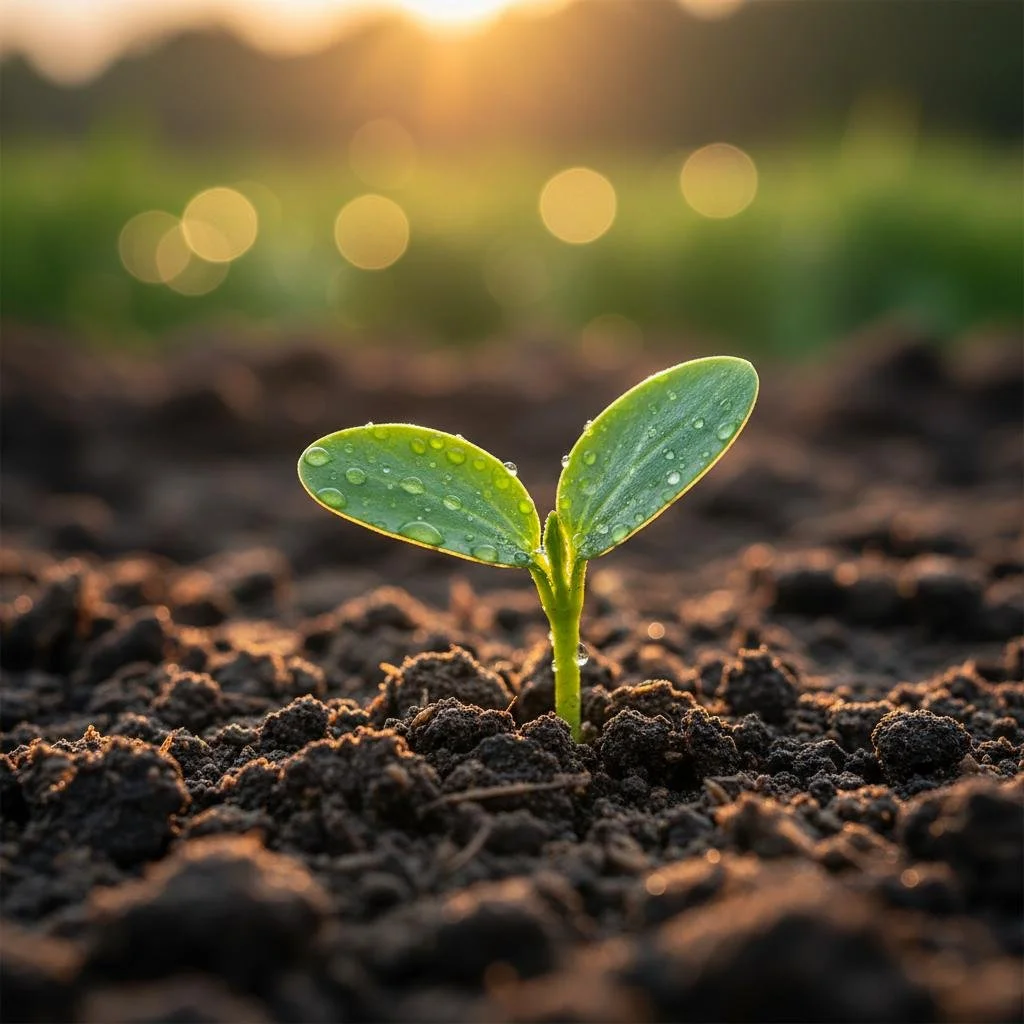
The stillness begins to shift. Seeds that have been resting beneath the soil start to germinate. Roots establish themselves, shoots appear and new growth begins.
This is where Wood enters the picture.
In the Five Element generating cycle, Water nourishes Wood.
Think about what happens in nature. Without water, a tree cannot grow. It needs nourishment, a stable foundation and the right conditions to develop.
The same relationship can be explored symbolically in our own lives.
Water represents our reserves, potential and inner resources. Wood represents our ability to take those resources and turn them into something meaningful.
It is the difference between knowing what you want and actually beginning to move towards it.
You can have a wonderful idea, a clear vision or a desire for change, but without movement, that potential remains just that: potential.
The transition from Water to Wood asks us an important question:
Now that you've reconnected with yourself, what are you going to do with what you've discovered?
2. UNDERSTANDING THE WOOD ELEMENT
The Five Element theory, also known as Wu Xing, is one of the philosophical frameworks used in Traditional Chinese Medicine.
The five elements are Wood, Fire, Earth, Metal and Water.
Rather than referring simply to physical substances, they describe five phases of movement and transformation that can be observed throughout nature and applied symbolically to human physiology and wellbeing.
Each element has its own characteristics, associated organ systems, emotions, seasons, colours and tissues.
Wood is associated with:
Season: Spring
Organs: Liver and Gallbladder
Emotion: Anger
Colour: Green
Climate: Wind
Sense organ: Eyes
Tissue: Sinews (tendons and ligaments)
Taste: Sour
Direction: East
Developmental phase: Birth and new growth

The central characteristics of Wood are movement, expansion, creativity, planning and flexibility.
Imagine a tree growing in an open field. Its roots establish a foundation, its trunk provides structure and its branches extend towards available light.
It needs direction, but it also needs the ability to adapt.
This is an excellent metaphor for the Wood Element in our lives.
We need goals, plans and a sense of purpose, but we also need the flexibility to change direction when circumstances require it.
In TCM, the Five Element relationships are used to understand the interconnected nature of the body's systems. They are a traditional theoretical framework, rather than a direct description of modern anatomical or physiological mechanisms.
3. THE LIVER: THE PLANNER AND STRATEGIST
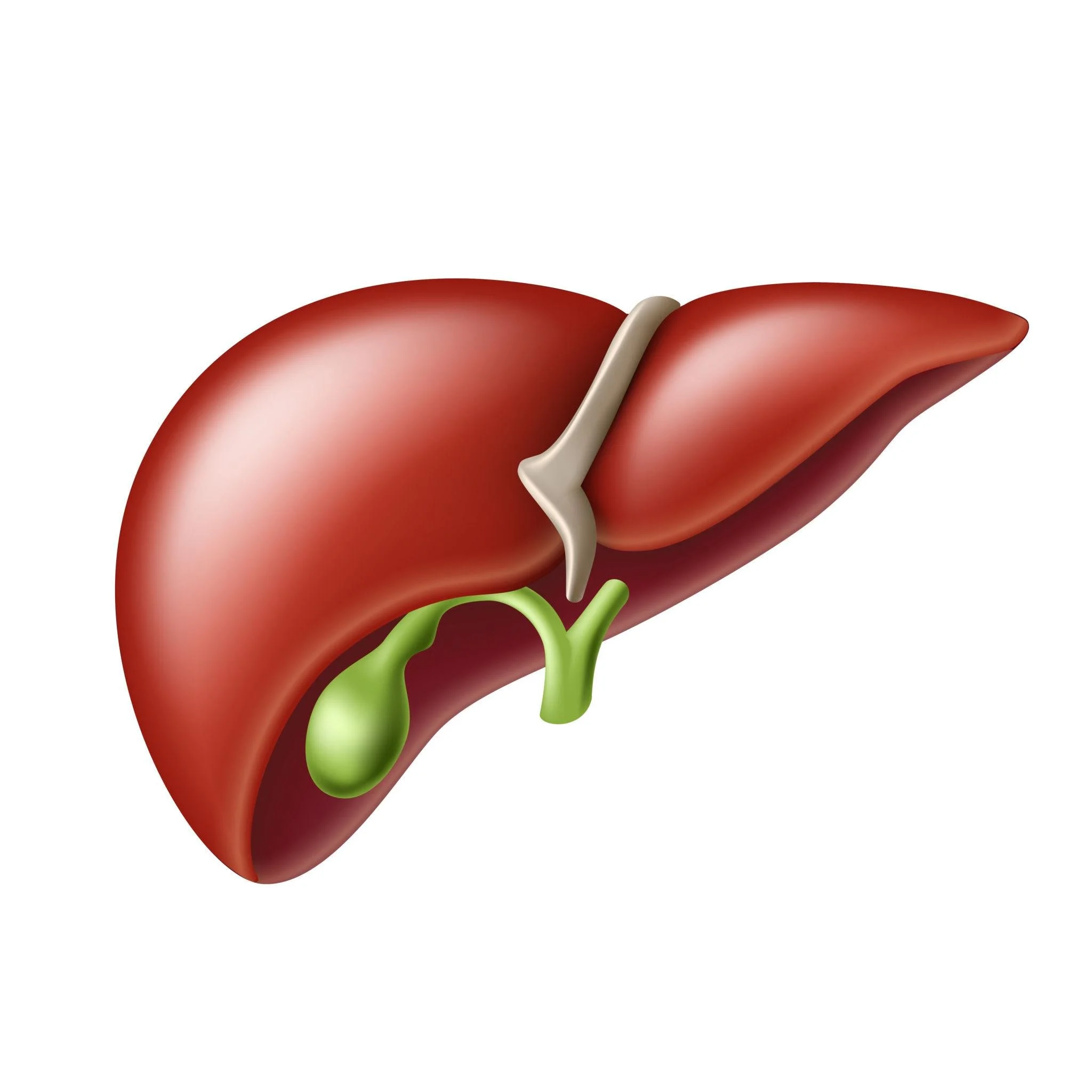
In Traditional Chinese Medicine, the Liver is often described as the General of the body.
It is associated with strategy, planning, vision and the smooth flow of Qi throughout the body.
Now, an important distinction: when TCM practitioners talk about the Liver, they are referring to a broader functional system within traditional Chinese medical theory. This is not identical to the anatomical liver described in Western medicine.
The Liver's traditional functions include:
The smooth flow of Qi
One of the Liver's most important roles in TCM is maintaining the smooth movement of Qi throughout the body.
Think of Qi as movement and communication within the traditional TCM framework.
When this movement is disrupted, practitioners may describe the resulting pattern as Liver Qi stagnation.
Storing Blood
In TCM, the Liver is said to store Blood and help regulate its distribution according to the body's needs.
Governing the sinews
The Liver is traditionally associated with the tendons, ligaments and sinews. This is why the Wood Element is so closely connected with flexibility, movement and physical function.
Opening into the eyes
The eyes are traditionally associated with the Liver system in TCM. Vision is also an interesting metaphor for the Wood Element's ability to look ahead, identify opportunities and establish direction.
The Liver as our internal strategist
Imagine trying to organise a major project without a plan.
You have the resources, the motivation and the desire to achieve something, but there is no clear direction.
Everything becomes reactive. You move from one problem to another, become frustrated when things don't go according to plan and struggle to prioritise what matters.
This is the kind of experience that the traditional Wood Element analogy helps us explore.
It reminds us of the importance of having a vision, organising our resources and maintaining the flexibility to adjust our plans.
A question to consider:
Are you actively directing your life, or are you simply reacting to whatever comes your way?
4. THE GALLBLADDER: FROM PLANNING TO ACTION
If the Liver is the strategist, the Gallbladder is often described as the decision-maker.
In TCM, the Gallbladder is paired with the Liver and is associated with courage, decisiveness and the ability to turn plans into action.
You can have the most beautifully organised plan in the world, but if you never make a decision or take the first step, very little changes.
This is where the relationship between the two Wood organs becomes interesting.
The Liver develops the strategy.
The Gallbladder supports the ability to make decisions and act on it.
Consider the following:
You want to change careers, but keep postponing the decision.
You know a relationship needs attention, but avoid having the conversation.
You have a business idea, but continually find reasons not to start.
You recognise that your lifestyle needs to change, but struggle to commit to a new direction.
Sometimes the challenge isn't that we don't know what we want.
It's that we struggle to move from intention to action.
The Wood Element encourages us to explore both sides of this relationship: having a vision and finding the confidence to take the next step.
Planning without action creates stagnation. Action without planning creates chaos.
The two need to work together.
5. THE EMOTIONAL SIDE OF WOOD: UNDERSTANDING FRUSTRATION AND ANGER
The emotion associated with Wood in TCM is anger.
But anger is a much broader concept than simply losing your temper.
It can include frustration, irritability, resentment, impatience and the feeling that something is preventing you from moving forward.
Think about the last time something didn't go according to plan.
Perhaps someone changed an arrangement at the last minute, a project became unnecessarily complicated or you felt that your efforts weren't being recognised.
How did you respond?
Did you become impatient? Did you feel tension building? Did you find yourself becoming frustrated over things that normally wouldn't bother you?
In TCM, these experiences can be explored through the relationship between Liver Qi and emotional regulation.
When movement becomes restricted
Imagine a river flowing freely.
Water moves around obstacles, follows the landscape and finds its way forward.
Now imagine that river becoming blocked.
The water no longer moves freely. Pressure builds and the natural flow is disrupted.
This is one of the metaphors traditionally used to explain Liver Qi stagnation.
In everyday life, we can experience something similar when we feel trapped, overwhelmed, restricted or unable to express ourselves.
We might become:
More easily irritated.
Impatient with ourselves or others.
Frustrated by small obstacles.
Indecisive or mentally restless.
Less creative or motivated.
Resistant to change.
These experiences do not automatically mean someone has Liver Qi stagnation. In TCM, a practitioner considers the wider pattern of symptoms and individual presentation.
Nor should anger or frustration be viewed as inherently negative.
Anger can tell us that a boundary has been crossed, something feels unfair or an important need is not being met.
The question is not how to eliminate anger.
It is how to understand it, respond constructively and prevent it from becoming the only way we communicate with ourselves and others.
A little emotional flexibility
Instead of immediately reacting when frustration appears, try asking yourself:
What exactly is frustrating me?
Is this something I can change?
Am I holding onto an expectation that needs to be reconsidered?
What would a more flexible response look like?
What is one constructive action I can take?
Sometimes the most productive response is not to push harder, but to change our approach.

6. FLEXIBILITY: THE SECRET TO SUSTAINABLE GROWTH
One of the most beautiful characteristics of the Wood Element is flexibility.
A young tree bends with the wind. Its branches move, its roots adapt and its growth responds to the environment.
A rigid tree may struggle when conditions change.
This gives us an interesting perspective on how we approach life.
We often associate success with determination, discipline and persistence.
And these qualities certainly matter.
But what happens when determination becomes stubbornness?
When discipline becomes rigidity?
When our need to control every outcome prevents us from recognising a better opportunity?
There is a difference between being committed to a goal and being unwilling to adapt.
The difference between flexibility and giving up
Flexibility doesn't mean abandoning your values or changing your goals every time something becomes difficult.
It means recognising that there may be more than one way to reach a destination.
You can maintain your direction while changing your route.
You can remain committed to your vision while adjusting your expectations.
You can acknowledge that something isn't working without viewing it as a personal failure.
This is an important lesson for relationships, careers, business, personal development and general wellbeing.
Sometimes growth means pushing forward.
Sometimes growth means stepping back, reassessing and choosing a different approach.
And sometimes growth means accepting that the person you were when you made a particular plan is not necessarily the person you are today.
The goal isn't to become unbreakable. It's to become adaptable.
7. THE WOOD ELEMENT AND THE BODY: MOVEMENT, SINEWS AND PHYSICAL FLEXIBILITY
The Wood Element has a particularly interesting relationship with physical movement.
In TCM, the Liver is said to govern the sinews, which include the tendons and ligaments.
This traditional association connects Wood with physical flexibility, movement and the body's ability to respond to changing demands.
It also gives us a reason to explore the relationship between physical and emotional tension.
Have you ever noticed how your body responds when you're stressed?
Perhaps you find yourself holding tension in your shoulders, clenching your jaw or feeling generally stiff and uncomfortable.
Stress can influence muscle tension and our perception of physical discomfort. However, these experiences have many possible causes and should not automatically be attributed to a TCM Liver pattern.
The importance of movement
Modern research gives us another interesting perspective.
Regular physical activity is associated with benefits for both physical and mental health. The World Health Organization recognises that movement can help reduce symptoms of anxiety and depression, support brain health and improve overall wellbeing.
This is particularly relevant to our Wood Element theme.
Movement doesn't always need to mean an intense workout or a demanding exercise programme.
It can be as simple as:
Taking a walk outdoors.
Practising gentle stretching.
Trying yoga or Tai Chi.
Dancing to your favourite music.
Taking regular movement breaks during the working day.
Spending time gardening.
The important thing is finding forms of movement that are appropriate for your abilities, enjoyable and sustainable.
Three acupuncture points associated with Wood
There are three particularly interesting acupuncture points we introduced in our November newsletter.
LV3 – Taichong: The Great Surge
Located on the top of the foot, between the first and second metatarsal bones.
LV3 is traditionally used in TCM to promote the smooth flow of Liver Qi and is frequently incorporated into treatments involving Liver Qi stagnation.
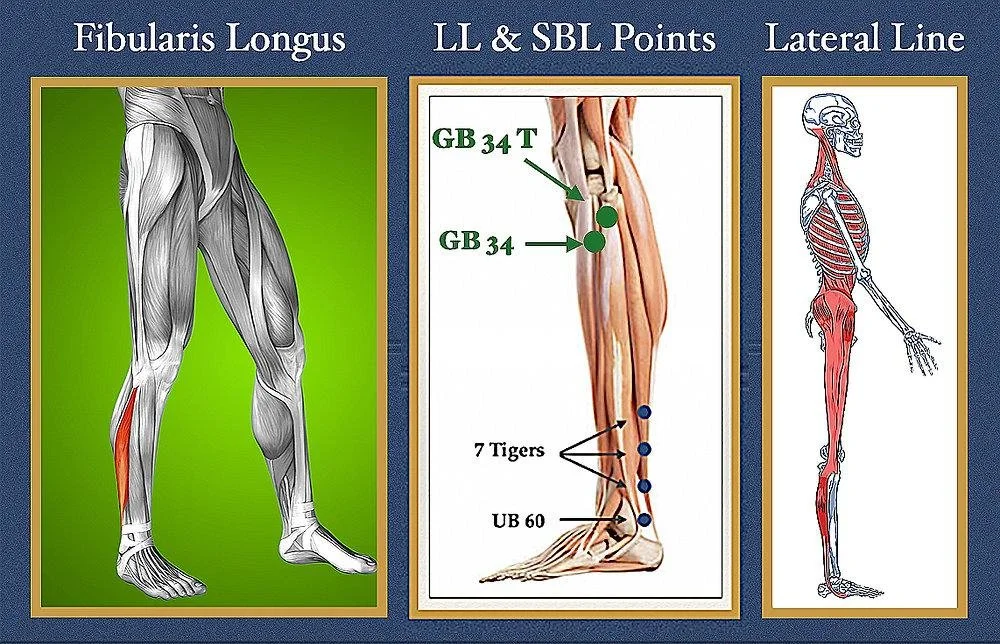
GB34 – Yanglingquan: The Influential Point of the Sinews
Located on the outer side of the lower leg, just below and slightly in front of the head of the fibula.
GB34 is traditionally known as the influential point of the sinews. It has an important place in TCM treatments involving musculoskeletal tension and restricted movement.
GB31 – Fengshi: The Wind Market
Located on the outer thigh, traditionally identified with the arms relaxed at the sides.
GB31 is a Gallbladder meridian point traditionally used in treatments involving Wind-related patterns and certain presentations affecting the lateral thigh and leg.
These points demonstrate some of the traditional relationships between the Wood Element, the Liver and Gallbladder meridians, and physical movement.
Their selection in clinical practice depends on the individual's presentation and overall TCM assessment.
8. NOURISHING YOUR WOOD ELEMENT: PRACTICAL WAYS TO FIND YOUR FLOW
You don't need to make dramatic changes to your life to begin exploring the Wood Element.
Often, small and consistent adjustments can help us reconnect with a sense of direction.
Here are six ways to bring the principles of Wood into everyday life.
1. Get moving
Movement is one of the most straightforward ways to introduce more activity into your day.
Take a walk, stretch, dance or try something new.
If you spend most of your day sitting, introduce regular movement breaks.
You don't need to achieve a particular fitness target to benefit from moving more.
2. Make space for creativity
Wood is associated with creativity and the ability to envision possibilities.
Try doing something that allows you to think differently.
Paint, cook, write, garden, play an instrument or start a project simply because it interests you.
Creativity doesn't have to be productive to be valuable.

3. Spend time in nature
Nature is one of the most obvious expressions of the Wood Element.
Take a walk among trees, visit a botanical garden or spend some time outside without constantly checking your phone.
Modern research has explored associations between exposure to green spaces and mental wellbeing, although the strength of evidence varies between studies.
You don't need to travel far to reconnect with nature.
Even a little greenery in your daily environment can provide an opportunity to pause and reset.
4. Create a vision
Take some time to think about where you want to be.
Not just professionally, but emotionally, socially and personally.
What would you like to experience more of?
What would you like to change?
What have you been postponing?
A vision doesn't have to be a perfectly detailed five-year plan.
It simply needs to give you somewhere meaningful to begin.
5. Practise flexibility
Notice where you might be holding onto expectations that are no longer serving you.
Are you insisting that something must happen in a particular way?
Are you resisting a change that could actually create a better opportunity?
Try considering an alternative approach before deciding that something isn't possible.
6. Give frustration somewhere constructive to go
Instead of allowing frustration to build, find a healthy way to acknowledge and work through it.
This might involve journalling, speaking to someone you trust, setting a boundary, taking a walk or addressing the problem directly.
Remember that persistent emotional distress deserves support, and there is no need to navigate it alone.
9. THE WOOD ELEMENT IN THE FIVE ELEMENT CYCLE
The Five Elements don't operate independently.
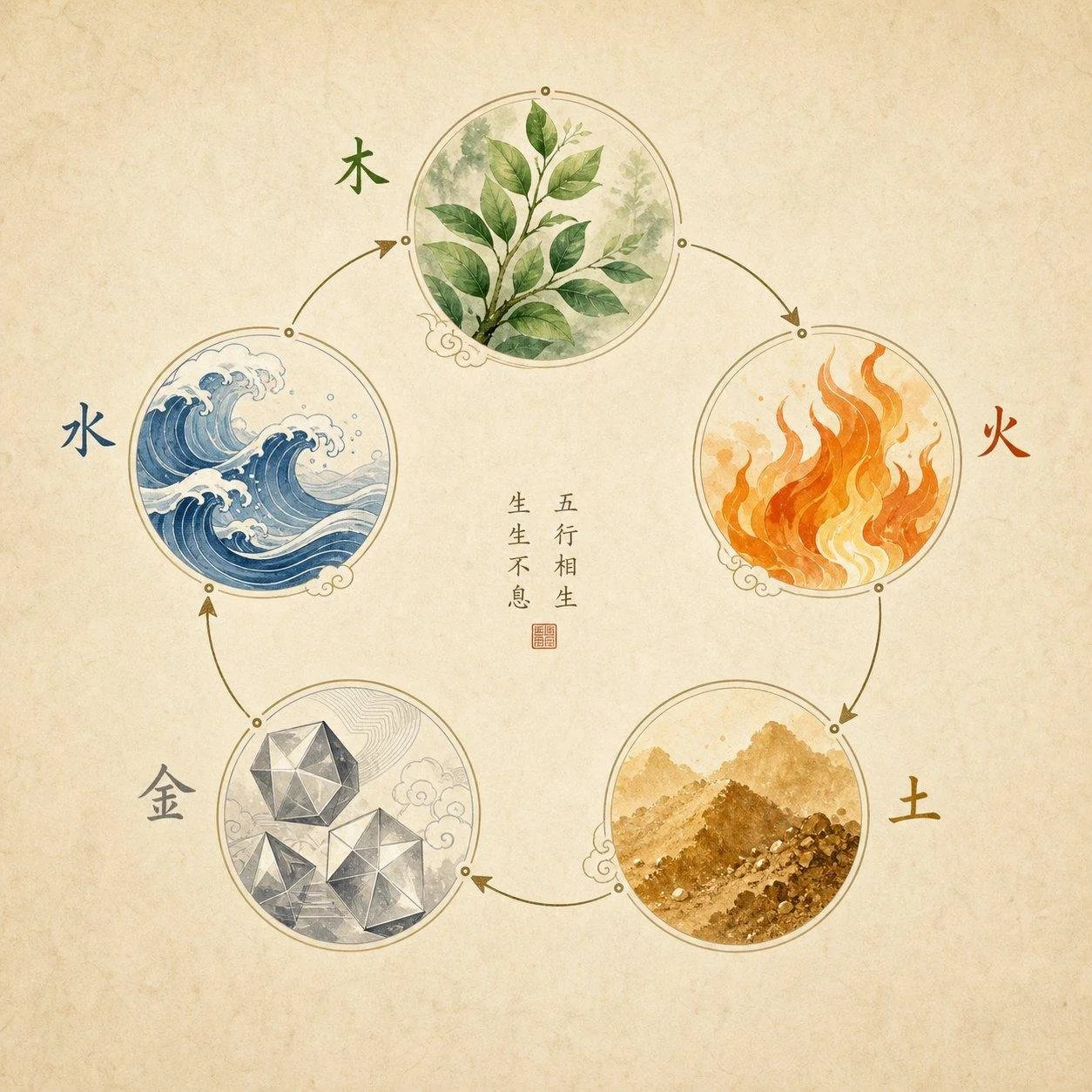
They are constantly interacting through two important relationships: the generating cycle and the controlling cycle.
Understanding these relationships helps us appreciate why the Wood Element is not simply about growth.
It is about balanced growth.
The generating cycle
Water nourishes Wood.
Wood generates Fire.
Fire creates Earth.
Earth generates Metal.
Metal generates Water.
Each element supports and nourishes the next.
Wood receives nourishment from Water and provides the foundation for Fire.
In our personal lives, we can think of this as a progression:
Water: Restore yourself and reconnect with your inner resources.
Wood: Develop direction, motivation and a plan.
Fire: Bring your ideas into the world with enthusiasm, connection and expression.
The controlling cycle
The elements also regulate one another.
Wood controls Earth.
Earth controls Water.
Water controls Fire.
Fire controls Metal.
Metal controls Wood.
This is not about one element being better or stronger than another.
It represents the importance of regulation, boundaries and balance.
Growth without regulation can become excessive. Planning without rest can become exhausting. Determination without flexibility can become rigidity.
The Five Element model reminds us that healthy systems require both nourishment and regulation.
10. THE WOOD ELEMENT REFLECTION: WHAT ARE YOU READY TO GROW?
This is where the Wood Element becomes personal.
Understanding the theory is interesting, but the real value comes from considering how it relates to your own life.
Take a few minutes to answer the following questions honestly.
There are no right or wrong answers.
Your direction
What areas of my life currently feel purposeful and exciting?
Where do I feel stuck or directionless?
What have I been wanting to do but continually postponing?
If I could make one meaningful change, what would it be?
Your flexibility
Where am I being too rigid?
Am I holding onto expectations that no longer serve me?
How do I respond when things don't go according to plan?
What might happen if I allowed myself to approach a challenge differently?
Your emotional landscape
What situations tend to trigger frustration or irritability?
Do I communicate my needs clearly?
Am I setting appropriate boundaries?
What do I need to acknowledge rather than continue avoiding?
Your growth
What would I like to learn?
What would I like to create?
What part of myself would I like to reconnect with?
What is one small action I can take this week?
Your Wood Element intention
Complete the following sentence:
I am ready to grow by...
Write down whatever comes to mind.
Don't overthink it. Allow yourself to consider the possibilities before deciding whether they are realistic or achievable.
You can work out the practical steps afterwards.
11. A FINAL THOUGHT: GROWTH DOESN'T HAVE TO BE LINEAR
We live in a world that constantly encourages us to do more, achieve more and move faster.
We measure progress through milestones, deadlines, promotions, financial achievements and the number of things we manage to accomplish.
But nature operates differently.
A tree doesn't grow at the same rate every day. It responds to its environment, develops its roots, strengthens its structure and changes with the seasons.
Sometimes growth is visible.
Sometimes it happens beneath the surface.
And sometimes what looks like stillness is simply preparation for something new.
The Wood Element reminds us that having direction is important, but so is knowing when to adapt.
It encourages us to embrace ambition without becoming rigid, to recognise frustration without being controlled by it, and to take action without losing sight of our own wellbeing.
Perhaps the question isn't how much more you can accomplish.
Perhaps it's whether you're growing in a direction that genuinely matters to you.
You don't have to become a completely different person to grow. You simply have to give yourself the space and conditions to become more of who you are.
EXPERIENCE THE WOOD ELEMENT
The Wood Element Workshop
Saturday, 28 November 2026 | The Acupuncture Centre, Rosebank, Cape Town
Growth. Direction. Flexibility. Finding Your Flow.
Reading about the Five Elements is one thing. Taking the time to experience their principles through guided reflection, relaxation and traditional Chinese medicine is something quite different.
We invite you to join us for our upcoming Wood Element Workshop.
This immersive experience is designed to help you explore the Wood Element in greater depth, understand its relationship with the Liver and Gallbladder, and reflect on the themes of personal direction, emotional balance, flexibility and growth.
Together, we'll explore:
The Wood Element and its place in the Five Element cycle.
The Liver and Gallbladder from a TCM perspective.
Understanding frustration, anger and emotional balance.
Vision, decision-making and finding your direction.
The importance of flexibility and adapting to change.
Practical ways to incorporate the Five Element philosophy into everyday life.
Through a combination of TCM education, experiential activities, guided reflection and relaxation, you'll have an opportunity to step away from the demands of everyday life and reconnect with yourself.
Whether you've attended one of our previous Five Element workshops or are completely new to the concept, you're welcome.
EVENT DETAILS
Saturday, 28 November 2026
Venue: The Acupuncture Centre, Rosebank, Cape Town.
Time: 9AM
Investment: R900
Bookings: Via Whatsapp +27824888608
Spaces are limited.
Come and discover what it means to grow with intention, move with purpose and remain flexible along the way.
[BOOK YOUR PLACE]
At The Acupuncture Centre, we believe that wellbeing is about more than addressing symptoms. It is about understanding the individual, creating balance and supporting meaningful change.
The Acupuncture Centre
Traditional Chinese Medicine | Acupuncture | Coaching | NLP | Hypnotherapy
Cape Town, South Africa
www.theacupunctureclinic.co.za
Grow with intention. Move with purpose. Stay flexible.
